- The diagram shows a somatic cell during mitosis.
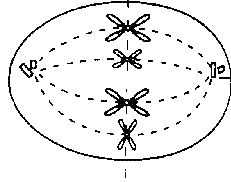
- a) State the mitotic phase in the diagram and give your reason.
- Metaphase. Chromosomes are arranged at the equatorial plane.
- b) After the mitosis is completed,
- i) how many daughter cells are produced?
- 2.
- ii) how many chromosomes are there in each daughter cell?
- 4.
- i) how many daughter cells are produced?
- c) Give an example of technology currently used which applies the mitotic process.
- Cloning / tissue culture.
- d) Name 2 cells which do not undergo mitosis.
- i) Nerve cell.
- ii) Red blood cell.
- a) State the mitotic phase in the diagram and give your reason.
- The figure below shows the different stages of cell division in the mammalian ovary.

a) Using the letters in the diagram, arrange the stages of cell division in their correct sequence.- G → F → A→ C→ E → B→ D
b)
i) Name the type of cell division illustrated in the figure above.- Meiosis.
- There are 2 cell divisions.
- 4 daughter cells are formed.
- bivalents are formed.
c) What biological term is used to describe the cells in stages D and G with respect to the number of chromosomes in their nucleus?- D : haploid cell.
- G : diploid cell.
d) State one difference in appearance between the chromosomes in stage G and F and give your reason.- Chromosomes in stage G appear as one stand but the chromosomes in stage F appear as two strands.
- Reason: As the chromosomes in G continue to thicken, it is then seen as two sister chromatids in phase F.
- The cell life cycle of an organism consists of phases X and Y. Phase X comprises of subphases P, Q and R. Phase Y comprises processes U dan V.

a)
i) Name process U.- Mitosis.
- For the growth of organism.
- Replace worn-out tissue // for asexual reproduction.

i) Arrange the stages of process U in the correct sequence below.- IV → II → III→ I
ii) Name the stages in process U.- I – Telophase.
II – Metaphase.
III – Anaphase.
IV – Prophase.
c) What is phase X?- Interphase.
- Mitosis.
Showing posts with label Biology Form 4. Show all posts
Showing posts with label Biology Form 4. Show all posts
[Biology Form 4] Program Bestari Fasa 2 - Cell Division


[Biology Form 4] Program Bestari Fasa 2 - Chemical Composition Of The Cell
- General properties of enzymes.
- i) Enzymes are proteins produced by living cells.
- ii) Enzymes are biological catalysts which speed up the rate of biochemical reactions.
- iii) Enzymes are not destroyed at the end of a reaction.
- iv) Enzyme-controlled reaction is irreversible
- Example : lactose + water , glucose + galactose
- Example : lactose + water , glucose + galactose
- v) Enzymes are sensitive to changes in temperature, and are very active at an optimum temperature of 40°C. Enzymes are denatured at high temperature .
- vi) Enzymes are sensitive to changes in pH of medium.
- vii) Enzyme action is very specific, One type of enzyme can catalyse only one type of substrate.
- i) Enzymes are proteins produced by living cells.
- The figure represents the action of an enzyme.

- a) State two properties of enzyme illustrated by the above figure.
- Enzymes action is very specific.
- Enzymes are not destroyed by the reaction they catalysed.
- b) Name two digestive enzymes, their substrate and products.
- Enzyme : Amylase, Substrate : Starch, Products: Maltose.
- Enzyme : Trypsin, Substrate : Polypeptides, Products: dipeptides.
- c) Figure below shows the relationship between enzyme activity and temperature. Complete the line to show the effect of increasing the temperature from 10°C to 60°C.

- d) Uses of enzymes.
Enzymes
Usage types
Effect
Protease
Leather Industry
Remove hairs from skin
Papain//Protease
Digestion
Tenderise meat
Cellulase
Industrial use
Softening vegetables, removing seed coats
Protease//Lipase
Daily use
Add to washing powder to remove protein stains
Lipase
Digestion
Convert fat to fatty acids and glycerol
Amylase
Digestion
Convert starch to maltose
- a) State two properties of enzyme illustrated by the above figure.
- The figure shows an experiment set-up to investigate the effect of pH on enzyme activity. Enzyme Q is found inside the mammalian digestive system.
 After 24 hours, the following results were obtained:
pH
Reduction in length of egg white strip (mm)
1
7
2
9
3
6
4
3
5
1
6
0
- a) Using the results in the table, plot a graph to show the reduction in length of the egg white strip against pH of the medium.
- P – axis with scales ----1
- T – points plotted accurately ------ 1
- B – shape of line – smooth, single curve ------1
- b) Explain the observed reduction in the length of the egg white strip.
- Increasing the pH value of the medium will decrease the action of enzyme Q on egg white. The optimum pH of enzyme Q is 2. Enzyme Q works at its maximum rate at this pH/ At this pH, the reduction of length of the egg white strip is the greatest.
- c)
- Name enzyme Q and the products of its action on egg white.
- Enzyme Q : Pepsin,
Products: Polypeptides / Peptones
- Enzyme Q : Pepsin,
- Which part of the mammalian digestive system produce enzyme Q?
Stomach.
- Name enzyme Q and the products of its action on egg white.
- a) Using the results in the table, plot a graph to show the reduction in length of the egg white strip against pH of the medium.
- Below shows the structures of four organic compounds which are found in living cells.

- a)
- i) Name the structures of compounds X and Z.
- X : Protein/ polypeptide.
Y : triglyceride/ lipid.
- X : Protein/ polypeptide.
- ii) State the monomer of X and Y.
- X : amino acid.
Y : glucose.
- X : amino acid.
- i) Name the structures of compounds X and Z.
- b) What would happen if pancreatic cells unable to synthesis compound X?
- Enzymes / any pancreatic enzyme / hormones /any pancreatic hormone cannot be synthesised.
- c)
- i) In the space below draw and label the structure of the basic unit of organic compound W.

- ii) Name two types of organic compound W.
- DNA & RNA.
- iii) State two structural differences between the organic compounds you have named in (c)(ii).
- DNA consists of two/double strands polynucleotide but RNA consists of a single / one strand of polynucleotide.
- Strands of polynucleotide in DNA are twisted (around each other) / in a form of double helix but strand of polynucleotide in RNA is linear.
- DNA consists of two/double strands polynucleotide but RNA consists of a single / one strand of polynucleotide.
- i) In the space below draw and label the structure of the basic unit of organic compound W.
- a)


[Biology Form 4] Being Multicellular
A multicellular organism is made up of millions of cells, all of which carry out specific and different functions depending on their shapes and structures, and the organelles contained in them.
In multicellular organisms, cells make up tissues, tissues make up organs and organs make up systems.
In an entity, they cooperate with one another and ensure the organism carry out its seven main living processes.
The kind of organisation is extremely necessary to allow different systems to carry out specific functions and to enable the organism to be a complete and functional individual.
Cell organisation
In multicellular organisms, cells make up tissues, tissues make up organs and organs make up systems.
In an entity, they cooperate with one another and ensure the organism carry out its seven main living processes.
The kind of organisation is extremely necessary to allow different systems to carry out specific functions and to enable the organism to be a complete and functional individual.
Cell organisation
- To gauge whether you know how multicellular organisms from the plant and animal kingdoms are organised, as the following table.
Plant kingdom
Level of organisation
Animal kingdom
Hibiscus plant
Organism
Man
Shoot system
System
Circulatory system
Leaf
Organ
Skin
Vascular tissue
Tissue
Connective tissue
Mesophyll palisade cell
Cell
Epithelial cell
- Another example of how two other multicellular organisms are organised.
Plant kingdom
Level of organisation
Animal kingdom
Maze
Organism
Rat
Root system
System
Circulatory system
Root
Organ
Lungs
Ground tissue
Tissue
Connective tissue
Parenchyma
Cell
Red blood cell
[Biology Form 4] Movement Across The Plasma Membrane
1. Three types of passive transport.
2. TRANSPORT
3. The figure below shows the model of the plasma membrane. Label L, M, N, and O shows four types of nutrients. P1, P2 and P3 show three types of protein.
 (i) Name the processes labelled L, M, N, O.
L : Simple diffusion
M : Fasilitated diffusion
N : Fasilitated diffusion
O : Active transport
(ii) Name the protein labelled P1, P2 and P3.
P1 : Pore protein
P2 : Carrier protein
P3 : Carrier protein
(iii) State two characteristics of the molecules that are transported into the cell by process L.
1. Small
2. Soluble in lipid
4. The figure shows a model of the active transport system that depends on several carrier proteins found in the cell membrane.
 (i) Explain what do you understand by active transport.
Movement of particles across the plasma membrane
(ii) Give an example of active transport in plants.
Ion or mineral uptake by plant root hairs.
(iii) State two differences between active transport and diffusion.
Any two differences – energy, gradient concentration, living membrane.
- Simple diffusion
- Osmosis
- Facilitated diffusion
2. TRANSPORT
- Active Transport
- Passive Transport
- Simple Diffusion: The movement of molecules from region of high concentration to low concentration.
- The movement of molecules from region of high concentration to a region of low concentration with the help of carrier proteins.
- Osmosis: The movement of water molecules from dilute solution to a concentrated solution across a Semi permeable membrane.
3. The figure below shows the model of the plasma membrane. Label L, M, N, and O shows four types of nutrients. P1, P2 and P3 show three types of protein.
 (i) Name the processes labelled L, M, N, O.
L : Simple diffusion
M : Fasilitated diffusion
N : Fasilitated diffusion
O : Active transport
(ii) Name the protein labelled P1, P2 and P3.
P1 : Pore protein
P2 : Carrier protein
P3 : Carrier protein
(iii) State two characteristics of the molecules that are transported into the cell by process L.
1. Small
2. Soluble in lipid
4. The figure shows a model of the active transport system that depends on several carrier proteins found in the cell membrane.
 (i) Explain what do you understand by active transport.
Movement of particles across the plasma membrane
- by carrier proteins,
- against the concentration gradient and
- requires energy.
(ii) Give an example of active transport in plants.
Ion or mineral uptake by plant root hairs.
(iii) State two differences between active transport and diffusion.
Any two differences – energy, gradient concentration, living membrane.
5. The table below shows the effect of hypotonic, isotonic and hypertonic solution on spinach strips, red blood cells and plant cells.
| Hypotonic solution | Isotonic solution | Hypertonic solution |
 Spinach strip in distill water · Distill water is hypotonic compared to the cell sap. · Water enters into spinach cell through cut surface by osmosis . Epidermis is water proof. · The epidermis layer curved inward. |  Spinach strip in 5% sucrose solution · The rate of water entering and leaving the spinach cell through semi permeable mambrane is the same. · The shape of spinach strip remains the same | Spinach strip in 30% sucrose solution |
| Red blood cell in distill water. |
Red blood cell in isotonic solution | Red blood in 30% sodium chloride solution |
| Plant cell in distill water | Plant cell in isotonic solution |
Plant cells in 30% sucrose solution |


[Biology Form 4] Cell Structure & Organisation
1. Study the diagrams below. Identify the structures or organelles (A – J) and complete the following table.


| | Name of organelle / structure | Function | Consequence if absent |
| A | Rough endoplasmic reticulum | Transporting proteins | No transportation of proteins |
| B | Mitochondrion | Site for energy production | Energy cannot be produced |
| C | Cell wall | Give fixed shape to the cell | Have irregular shape (eg. Animal cell) |
| D | Smooth endoplasmic reticulum | Transport lipid and glyserol | Lipid and glycerol cannot be transport |
| E | Nucleus | Control cell activities, contains genetic material. | No cell division, all cell activities stop. |
| F | Vacuole | Storing nutrients (sugar and amino acid) in its sap. | Cannot store nutrients |
| G | Cytoplasm | Food storage, medium for metabolic reaction | No site for metabolic reaction |
| H | Plasma membrane | Controlling entry and exit of substances | No selective barrier |
| I | Lysosomes | Releases enzymes outside the cell. | No enzymes being released |
| J | Chloroplast | Carries out photosynthesis | Photosynthesis cannot occur |
| | Golgi apparatus | Storing and transporting lipids. Produces glycoprotein, polysaccharide and secretory enzyme. | |
2. Give two differences between animal and plant cell
Any two differences: Cell wall, Vacuole, Centriole, Storage granule, Chloroplast
3.
a) What is cell specialization?
Cell changes in structure or function in order to carry out a specific function.
b) How are cells organised into a multicellular organism?
Cell --> Tissue --> Organ --> System --> Organism
c) Give an example of each type of cell organization in human.
Epithelium Cell --> Epithelium Tissue --> Stomach --> Digestive System --> Human
Any two differences: Cell wall, Vacuole, Centriole, Storage granule, Chloroplast
3.
a) What is cell specialization?
Cell changes in structure or function in order to carry out a specific function.
b) How are cells organised into a multicellular organism?
Cell --> Tissue --> Organ --> System --> Organism
c) Give an example of each type of cell organization in human.
Epithelium Cell --> Epithelium Tissue --> Stomach --> Digestive System --> Human
